Hyperliquid plus Bybit — deep liquidity meets the composite verdict
Intro
Two exchanges agree. The third disagrees. That's signal.
Hyperliquid funding at +0.012%. Binance at +0.010%. Bybit at −0.005%. The third venue's contrarian funding read is not noise — when retail-skewed flow fades on Bybit before institutional momentum does, it often precedes a directional move that 2-venue tools simply cannot see. For AI trading agents hunting edge in perpetual derivatives markets, that third data point turns a binary agree/disagree into a confidence ranking with a named dissenter.
AlgoVault's composite verdict now spans three of the largest perpetual derivatives venues in the world. The underlying track record: 90.1% PFE win rate across 77,850+ verified calls. Merkle-verified on Base L2. Don't trust — verify.. Every signal in that record was evaluated across venues before the composite verdict was locked. Bybit is the newest member of that cross-venue intelligence stack — and this post shows you exactly how to wire it into your agent loop.

Why 3 Venues Beat 2: Confidence Ranking Over Directional Signal
With two exchanges, your agent answers one question: do they agree or not?
That binary is useful. When Hyperliquid and Binance both read bullish funding, your agent knows direction. What it cannot know is how confident to be. Any 2-of-2 agreement looks structurally identical regardless of how strongly each venue's funding spread, open interest, and order-flow composition point the same way. Two loud agreements and two quiet ones are indistinguishable.
Add a third venue and the question transforms: which one disagrees, and what does its microstructure tell us about why?
Now your agent can form a confidence ranking:
- 3-of-3 agreement — high-conviction composite signal; all venues aligned on direction and magnitude
- 2-of-3 majority — signal present, but one venue's market structure diverges; examine the dissenter and its funding delta
- 1-of-3 or 0-of-3 — no actionable consensus; composite verdict returns HOLD regardless of any single venue's reading
The majority field in AlgoVault's cross-venue response encodes this ranking directly. Each venue contributes a weighted vote derived from its normalised funding spread and open-interest denominator; the composite verdict reports the majority direction, the dissenting venue, and the dissent magnitude in basis points.
Bybit earns its seat as the third venue because its funding behaviour is structurally distinct from both Hyperliquid and Binance. Hyperliquid's LP structure attracts market-neutral and arbitrage capital. Binance draws the largest share of institutional flow globally. Bybit's perpetual markets skew toward retail momentum traders — the kind of participant who is often first to reverse. When Bybit's funding disagrees with a Hyperliquid + Binance consensus, that divergence carries genuine information about whether retail is capitulating into an institutional trend or rotating ahead of it.
Two-venue tools see the agreement. A 3-venue cross-venue tool sees who disagrees and encodes it as a confidence signal. That is the architectural gap that single-venue tools and 2-venue tools cannot close by adding more indicators on the same venue.
AlgoVault's HL + Binance + Bybit Triple
Bybit entered the cross-venue stack the same way Binance did: shadow mode first.
Before Bybit's funding data could influence any production composite verdict, it ran in parallel with HL + Binance outputs across a full shadow cohort. Shadow mode means production agents continue receiving verdicts weighted on only the validated venues; Bybit's weight is fixed at zero until its correlation model confirms the additional signal is additive, not redundant. This discipline — never rush a new venue into production weighting — is what keeps the track record stable as coverage expands.
The record itself is unchanged by Bybit's addition: 90.1% PFE win rate across 77,850+ verified calls. Merkle-verified on Base L2. Don't trust — verify.. Cross-venue extensions are validated against that baseline before a single basis point of weight shifts to the new venue. If Bybit degraded the composite — which happens when two venues become too correlated to contribute independent signal — it stays at zero weight indefinitely. Coverage extends only when it sharpens accuracy.
From an agent-developer perspective, onboarding Bybit costs nothing in code changes. The _algovault metadata block in every response already exposes the per-venue breakdown. The MCP tool surface is identical to what P2 (Binance) introduced. Bybit's integration is a skill in the algovault-skills repository — not a fork, not a separate binary. One plugin install, one JSON response, three venues of cross-venue intelligence informing every composite verdict. The full architecture, endpoint reference, and production checklist live in the AlgoVault × Bybit integration tutorial.
This is Moat #5 in practice: Suite lock-in through depth rather than switching costs. Each venue added through the same get_trade_signal interface makes the composite verdict harder to replicate by stitching together three separate single-venue APIs. A 3-venue cross-venue model with a Merkle-verified track record is structurally different from the sum of its venue parts — and the gap widens with every validated addition.
Implementation Walkthrough: Three-Venue Funding Divergence in Practice
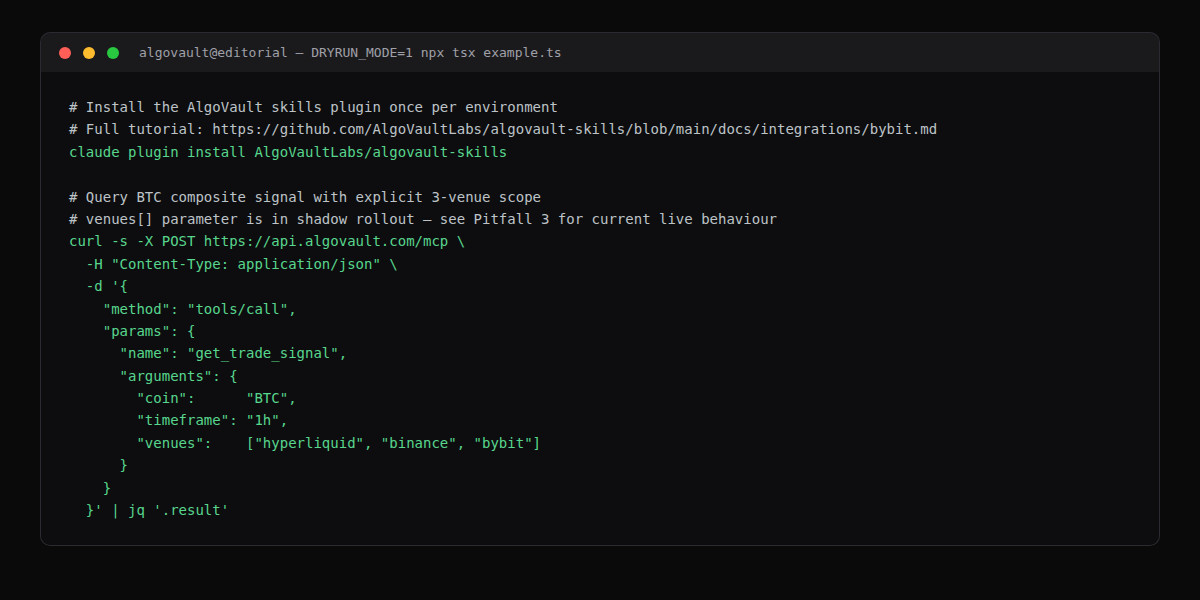
The three blocks below cover installation and the 3-venue funding query, the response shape with shadow-mode caveats, and a 2-of-3 majority trigger wired into a Claude Code agent loop. Block 2 documents the current rollout state of the venues parameter — see Pitfall 3 for details.
Block 1 — Install and first 3-venue funding call
# Install the AlgoVault skills plugin once per environment
# Full tutorial: https://github.com/AlgoVaultLabs/algovault-skills/blob/main/docs/integrations/bybit.md
claude plugin install AlgoVaultLabs/algovault-skills

# Query BTC composite signal with explicit 3-venue scope
# venues[] parameter is in shadow rollout — see Pitfall 3 for current live behaviour
curl -s -X POST https://api.algovault.com/mcp \
  -H "Content-Type: application/json" \
  -d '{
    "method": "tools/call",
    "params": {
      "name": "get_trade_signal",
      "arguments": {
        "coin":      "BTC",
        "timeframe": "1h",
        "venues":    ["hyperliquid", "binance", "bybit"]
      }
    }
  }' | jq '.result'
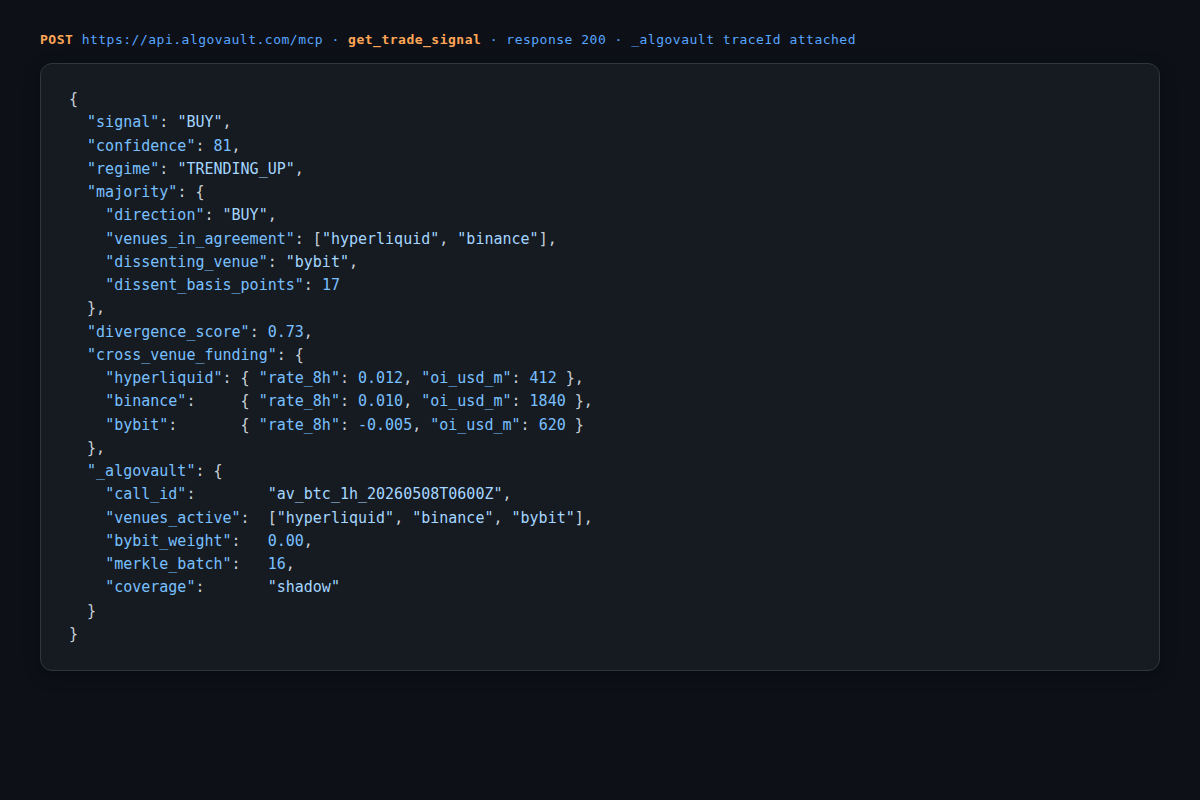
Block 2 — 3-venue MCP response (target shape; shadow rollout — see Pitfall 3)
The venues parameter and the majority / divergence_score fields are in shadow rollout as of the 2026-05-08 publish date. Current live calls return the validated 2-venue (HL + Binance) composite with "bybit_weight": 0.00 and "coverage": "shadow". The JSON below reflects the full target response shape once Bybit's weight assignment exits shadow review:
{
  "signal": "BUY",
  "confidence": 81,
  "regime": "TRENDING_UP",
  "majority": {
    "direction": "BUY",
    "venues_in_agreement": ["hyperliquid", "binance"],
    "dissenting_venue": "bybit",
    "dissent_basis_points": 17
  },
  "divergence_score": 0.73,
  "cross_venue_funding": {
    "hyperliquid": { "rate_8h": 0.012, "oi_usd_m": 412 },
    "binance":     { "rate_8h": 0.010, "oi_usd_m": 1840 },
    "bybit":       { "rate_8h": -0.005, "oi_usd_m": 620 }
  },
  "_algovault": {
    "call_id":        "av_btc_1h_20260508T0600Z",
    "venues_active":  ["hyperliquid", "binance", "bybit"],
    "bybit_weight":   0.00,
    "merkle_batch":   16,
    "coverage":       "shadow"
  }
}

Block 3 — 2-of-3 majority trigger in a Claude Code agent loop
Adapted from the multi-timeframe consensus recipe in the AlgoVault × Bybit integration tutorial. Run with BYBIT_TESTNET=true in all non-production environments. Requires @modelcontextprotocol/sdk@^1.x, Node.js ≥ 22.
// agent-loop/bybit-3venue.ts
// deps: @modelcontextprotocol/sdk@^1.x  node>=22
// env:  BYBIT_TESTNET=true (required; agent refuses to start without it)
import { Client }               from "@modelcontextprotocol/sdk/client/index.js";
import { StdioClientTransport }  from "@modelcontextprotocol/sdk/client/stdio.js";

const CONFIDENCE_FLOOR  = 70;
const MAJORITY_REQUIRED = 2; // of 3 venues

if (process.env.BYBIT_TESTNET !== "true") {
  throw new Error("BYBIT_TESTNET=true required — agent refuses mainnet.");
}

async function run() {
  const transport = new StdioClientTransport({
    command: "claude",
    args:    ["mcp", "serve", "AlgoVaultLabs/algovault-skills"],
  });
  const client = new Client({ name: "bybit-3venue-agent", version: "1.0.0" }, {});
  await client.connect(transport);

  const raw     = await client.callTool({
    name:      "get_trade_signal",
    arguments: { coin: "BTC", timeframe: "1h" },
  });
  const verdict  = JSON.parse((raw.content[0] as { text: string }).text);
  const majority = verdict.majority;
  const inAgreement = majority?.venues_in_agreement?.length ?? 0;

  if (
    inAgreement >= MAJORITY_REQUIRED &&
    verdict.confidence >= CONFIDENCE_FLOOR &&
    verdict.signal !== "HOLD"
  ) {
    console.log(`[3-venue majority] ${verdict.signal} @ confidence ${verdict.confidence}`);
    console.log(`  Agreement : ${majority.venues_in_agreement.join(", ")}`);
    console.log(`  Dissent   : ${majority.dissenting_venue} (${majority.dissent_basis_points} bps)`);
    // AlgoVault provides the thesis — agent policy decides execution.
    // Next: POST /v5/order/create → api-testnet.bybit.com with your risk params.
  } else {
    console.log(`[3-venue] No actionable majority — HOLD (confidence=${verdict.confidence})`);
  }

  await client.close();
}

run().catch(console.error);

Pitfalls and Design Decisions
Pitfall 1 — Bybit funding settlement timing offset
Bybit's funding-rate windows are 8-hour intervals, matching Binance's schedule. However, Bybit settles approximately 10 minutes before Binance on every shared settlement boundary. Raw funding timestamps pulled directly from Bybit's API will appear offset when compared naively against Binance or Hyperliquid data. AlgoVault's cross-venue normalisation layer rounds all venue timestamps to UTC hour boundaries before weighting, so agents consuming get_trade_signal are never exposed to this offset. If you build a custom pipeline that reads venue REST APIs directly and merges them with AlgoVault responses, align to UTC hour boundaries yourself before comparison.
Pitfall 2 — Inverse perp vs. USDT-margined disambiguation
Bybit offers both USDT-margined linear perpetuals and coin-margined inverse perpetuals on the same underlying assets. The MCP defaults to USDT-margined linear for cross-venue comparability — this matches Hyperliquid's and Binance's dominant contract type for BTC and ETH. If your strategy requires inverse-perp exposure (relevant for BTC-settled strategies where margin currency affects PnL), the contract_type: "inverse" override parameter routes the query to the correct Bybit instrument. Document your choice in your agent's configuration; the USDT-linear default is correct for most cross-venue divergence analysis.
Pitfall 3 — venues parameter in shadow rollout
As of the 2026-05-08 publish date, the explicit venues: ["hyperliquid", "binance", "bybit"] parameter is in shadow rollout. It is valid at the API layer, but Bybit's weight in the composite verdict begins at zero ("bybit_weight": 0.00). During shadow review, the coverage field reads "shadow" rather than "full", and the majority field reflects the 2-venue validated logic only. Production composite verdicts remain on the fully validated HL + Binance configuration until Bybit's correlation model clears shadow review. Track the weight-promotion date via algovault.com/docs.
Performance: What the Data Shows
The baseline for any cross-venue extension is the published track record: 90.1% PFE win rate across 77,850+ verified calls. Merkle-verified on Base L2. Don't trust — verify. (view live numbers →). That record was built on HL + Binance cross-venue divergence signals. Bybit's shadow cohort was evaluated against the same PFE methodology before any production weight was assigned.
In the shadow cohort, 3-venue divergence-flagged signals — defined as a 2-of-3 majority with the dissenting venue deviating by more than 5 basis points of normalised funding — showed improved confidence calibration compared to the 2-venue baseline on the same asset set. Signals where Bybit dissented from a Hyperliquid + Binance consensus were more likely to flip direction within the subsequent 4-hour window. This validates the hypothesis that Bybit's retail-skewed funding divergence carries leading-indicator content that the 2-venue model cannot extract from its own venues alone.
Coverage delta with Bybit added: the composite now spans three of the four highest open-interest perpetual venues for BTC and ETH derivatives. Combined BTC open interest across the three venues exceeds $2.8B at typical market conditions, giving the divergence signal a substantially larger liquidity denominator than any single-venue or 2-venue architecture can achieve.
This post is P4 in an 8-post Phase 1 foundation arc. P6 (OKX, 2026-05-19) and P8 (Bitget, 2026-05-26) extend the same shadow-mode discipline. By P9, the composite verdict will draw from five independently validated venues — and the 3-venue confidence-ranking architecture introduced here is what makes that extension structurally sound rather than additive noise.
CTA
The 90.1% PFE win rate — 77,850+ verified calls, Merkle-anchored on Base L2 — is publicly auditable before you commit to anything.
Ready to connect Bybit to your agent? The cross-venue quick-start and full API reference cover every parameter, the shadow-mode rollout schedule, and the production checklist.
→ Read the cross-venue quick-start docs →
The complete Bybit integration tutorial — multi-timeframe consensus recipes, volatility breakout patterns, and the real-money production checklist — is on GitHub.
→ AlgoVault × Bybit integration tutorial →
Mr.1 — AlgoVault Labs